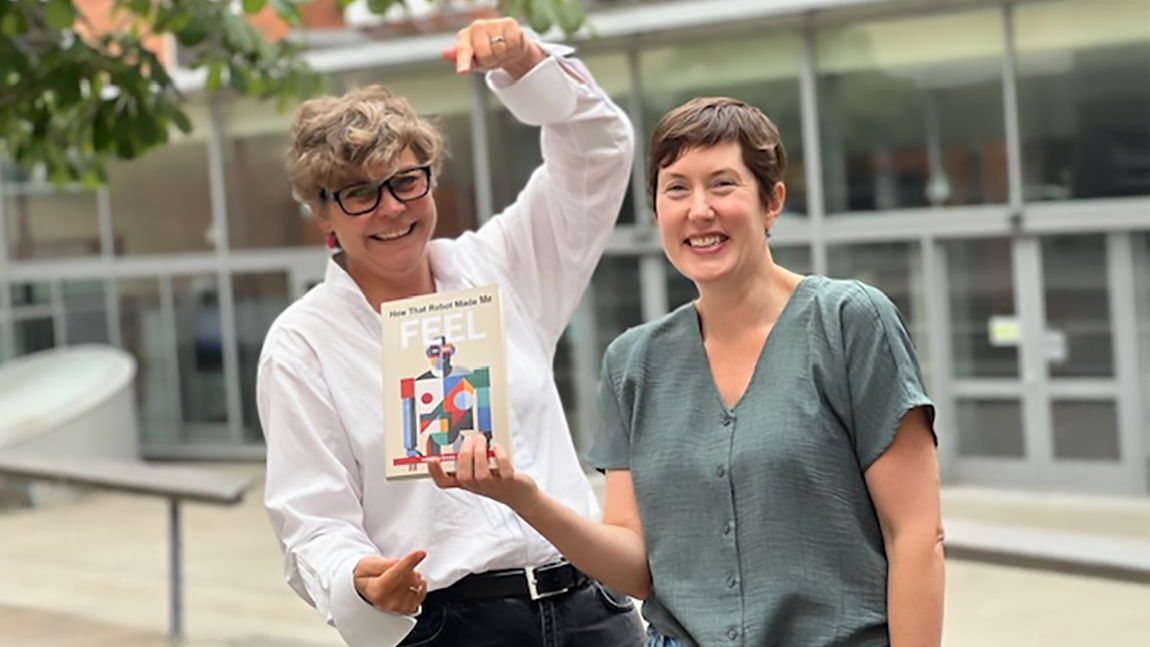
What emotions arise when you meet a robot? How do we react to them in different contexts and why are these emotional responses so important? These questions are raised in the new book, How that Robot Made Me Feel, which has grown out of a WASP-HS project co-led by Katherine Harrison, Ginevra Castellano and Ericka Johnson. A book launch for it will be hosted in conjunction with the WASP-HS conference AI for Humanity and Society on October 9.
Whether robots, or the artificial intelligence (AI) that powers them, can feel emotions is a topic of ongoing debate. It is a familiar theme in science fiction and a frequent headline in tech development. Just as important, though, is the question: How do we humans emotionally respond to robots? And how do those responses influence the way robots are designed, today?
“Emotions are not the same for everyone, everywhere. They are context and culturally dependent. By looking closely at how robots make us feel, and how those feelings are shaped, we can start to see the hidden politics behind their design. It is not just about cool tech; it is also about how that tech affects people in different ways,” says Ericka Johnson, Professor in Technology and Society at Linköping University.
Book Launch at WASP-HS Conference
To celebrate the release, a book launch – including a prestation by Iolanda Leite, KTH – will be hosted in conjunction with the WASP-HS conference “AI for Humanity and Society” at the Stockholm School of Economics.
“The research in How That Robot Made Me Feel was made possible through support from WASP-HS. It therefore feels especially meaningful to present the book at the WASP-HS conference, where important conversations about AI and society are actively taking place,” says Ericka.
The book launch takes place on October 9 at 10:00-11:00 in the KAW Lounge at Stockholm School of Economics. Iolanda Leite, Royal Institute of Technology, will introduce the book and contributing authors will be present for discussions over coffee and cake.