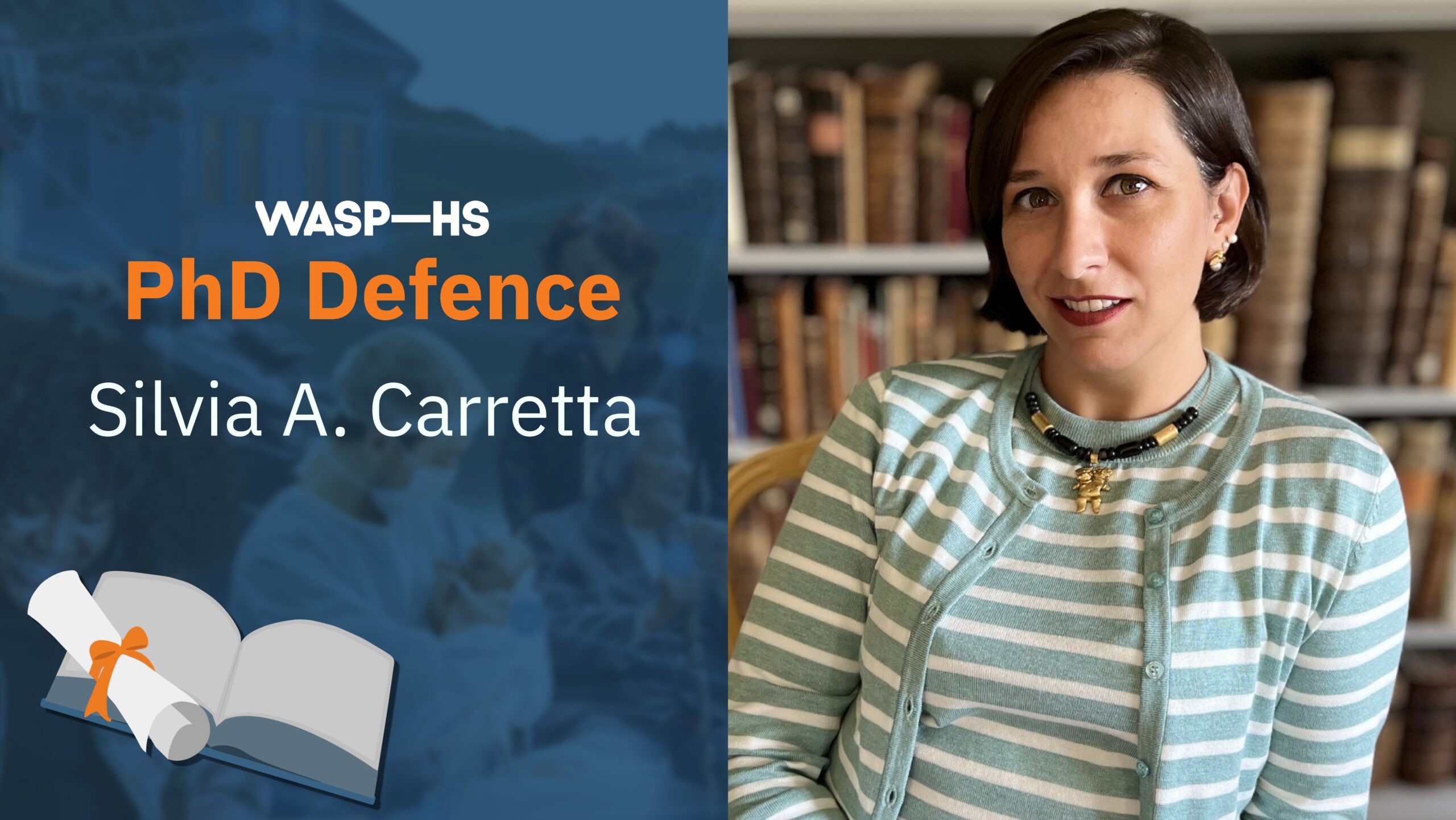
Silvia A. Carretta defends her doctoral thesis, “Online Content Moderation: The Regulatory Continuum from EU Regulation to Platform Self-Regulation” on September 26 at Uppsala University.
Abstract
In today’s digital landscape, users generate a staggering amount of content every minute. Some of this content poses serious legal challenges, including terrorist propaganda, copyright-infringing works, hate speech and disinformation. Online platforms are under growing pressure to moderate such content. They must comply with legal obligations to remove illegal content or risk liability, while remaining free to exercise discretion in enforcing private moderation policies to restrict lawful content they deem incompatible with their Terms and Conditions. This dual role raises pressing legal and societal questions about the balance between public regulation and the growing influence of private actors in governing online speech.
This book investigates how content moderation is regulated within the European Digital Single Market. While public regulation has been widely debated, there is a lack of insight into how the public and private regulatory spheres interact in this context. The study frames the issue within two complementary dimensions: the Regulation “of” platforms, involving binding legislative acts which mandate the removal of illegal content (most notably the Digital Services Act), and the Regulation “by” platforms, private governance mechanisms comprising co-regulatory initiatives beyond state-mandated obligations, self-regulation practices, and private rule-making embedded in online platforms’ Terms and Conditions.
The analysis is structured around the concept of a regulatory continuum and follows a theoretical classification of three modes of regulation: regulation stricto sensu, co-regulation and self-regulation. It is a pioneering study that systematically maps policy variables and governance instruments across each mode. Through selected case studies of major online platforms, the study innovatively examines how public and private regulatory frameworks interact, overlap and sometimes conflict in shaping platform and content governance across the regulatory continuum.
A timely and rigorous analysis, this study critically reflects on the Digital Services Act’s transformative impact on platform accountability and digital governance. It demonstrates that the two dimensions – Regulation “of” platforms and Regulation “by” platforms – should not be viewed as a dichotomy between public and private governance but as part of a dynamic, multi-actor regulatory process in the governance of the digital landscape.
Supervisors
Sandra Friberg, Associate Professor
Anna-Sara Lind, Professor
Magnus Strand, Associate Professor
Opponent
Mika Viljanen, Professor