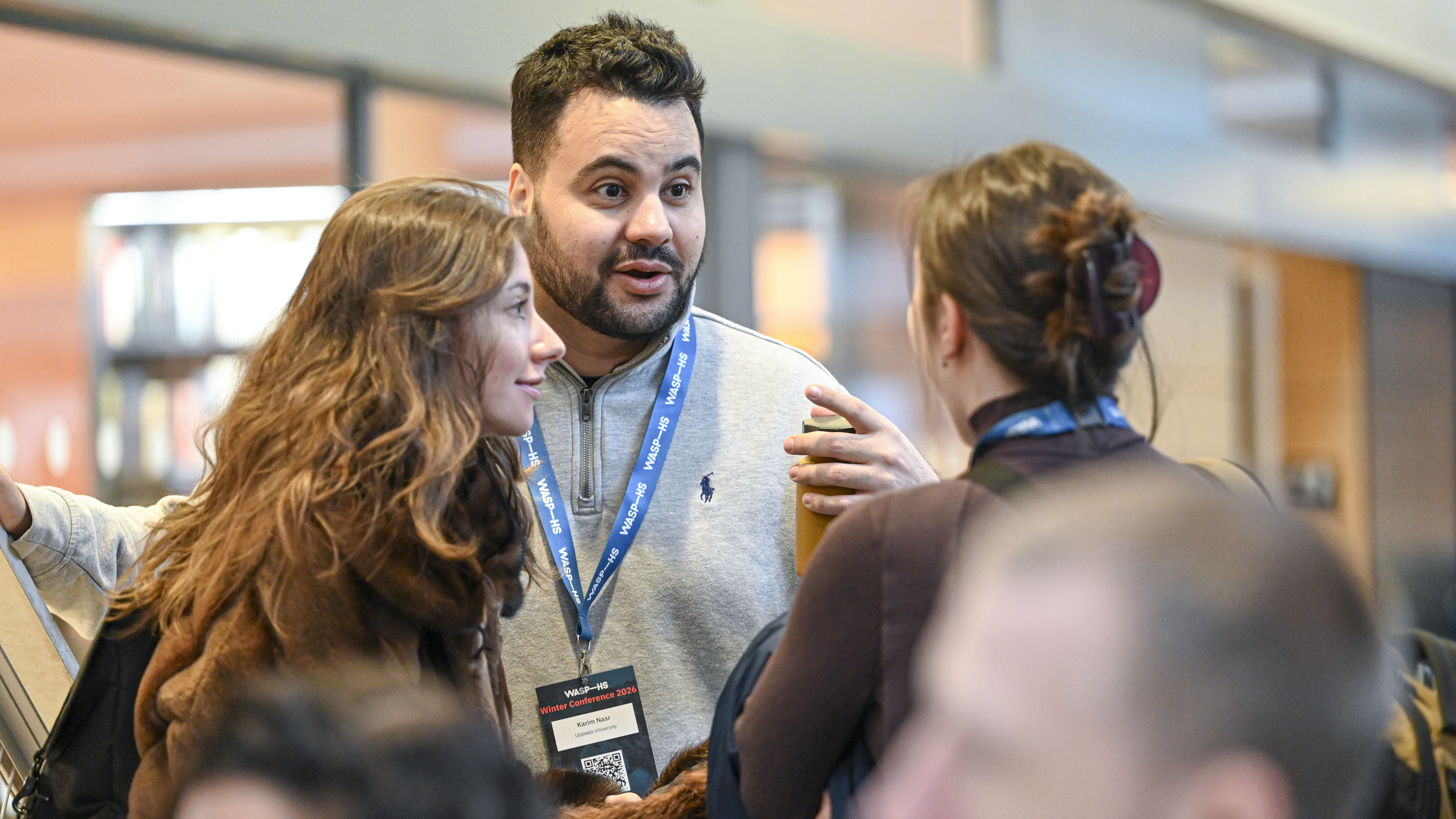
As generative artificial intelligence (AI) becomes part of creative processes, questions on copyright, licensing, and personality rights arise. Together with KLYS, WASP-HS welcomed researchers, legal experts, and representatives from the cultural sector to an open dialogue meeting on the topic on 4 November.
Together with KLYS, WASP-HS organized the dialogue meeting ”Utmaningar för kulturen och kulturskaparna i AI-utvecklingen” (Challenges for Culture and Cultural Creators in AI Development), where researchers, legal experts and cultural creators came together to discuss the impact of generative AI on the rights for culture and culture creator.
“If we want to maintain a cultural and creative industry worth SEK 650 billion annually, regulation around AI and mutual understanding is essential. That’s why dialogue meetings like this are so important,” said Josefine Engström, Chair of Svenska Tecknare
The event was introduced by Ulrica Källén, Chief Executive Officer at KLYS, and Katja de Vries, Senior Lecturer in Public Law at Uppsala University and researcher within WASP-HS.
After the introduction participants listened to the four keynote speakers Josefine Engström (Chair of Svenska Tecknare), Thorbjörn Öström (lawyer and founder of Öström Advokat, consultant for KLYS), Johan Axhamn (Associate Professor, Lund University), and Andreas Kotsios (Senior Lecturer in European Law, Uppsala University, WASP-HS).
Copyright, Licensing, and Personality Rights
After the presentations, participants were divided into three groups to discuss AI’s impact on copyright, licensing, and personality rights.
Copyright — Legal Ambiguity and Democratic Concerns
One key topic in the ongoing debate around generative AI is the definition of “lawful access” to online material. It became evident that determining what is legally permitted is complex, with no clear guidelines on who carries the burden of proof—whether it’s the AI developers, content platforms, or the creators themselves. This legal ambiguity creates uncertainty for all parties involved and underscores the need for clearer regulations and frameworks that define acceptable use of online content in AI training.
The discussion also brought forward the consumer perspective: if AI systems are denied access to high-quality content, the quality of their output inevitably declines. Over time, this could lead to a noticeable drop in the usefulness and creativity of AI-generated material. Interestingly, compensation for creators was not seen as the central issue. Instead, the greater challenge lies in the control mechanisms required by copyright law. Broader societal questions were raised as well, such as who gets visibility and representation in AI-generated content—making this not just a legal or technical issue, but a democratic one. There was a shared understanding that any viable solution must be inclusive and involve all stakeholders in the conversation.
Licensing — A Response When AI Development Can’t Be Stopped?
When generative AI first became publicly accessible, many creators voiced strong opposition to its use, primarily due to the widespread scraping of copyrighted material from the internet without consent. This raised serious ethical and legal concerns, especially among artists, writers, and other content creators whose work was being used to train AI models. The idea of halting the development of generative AI altogether was initially proposed by some, but over time, it has become clear that such a move is largely unrealistic given the rapid pace of technological advancement and adoption.
The discussion has shifted toward more pragmatic solutions, with licensing emerging as a potential path forward. This approach would allow creators to choose whether their work can be used in AI training processes, giving them agency and potentially compensation. Discussions around what fair and appropriate licensing terms might look like are still ongoing, and it’s evident that these conversations need to continue. Establishing transparent, equitable frameworks will be essential to balancing innovation with respect for intellectual property rights.
Personality Rights — Complexity of Unified Laws and Legal Gaps
This discussion was anchored in a Danish legislative proposal aimed at regulating and partially banning deepfakes – AI-generated manipulations of images, videos, or audio that falsely portray individuals. A central concern was identifying what should be protected: the commercial interests tied to names and brands, the safety and dignity of individuals, or both. Some participants suggested that the current legal framework may be insufficient and that a new digital right might be necessary to safeguard individuals from misuse and misrepresentation online.
The conversation also explored the challenges of enforcing such a ban. With digital platforms operating across borders and laws differing from country to country, creating unified regulations is complex. A European-level solution was proposed, but it was noted that personality rights have long been a contentious issue within the European Union. The group further debated platform accountability and whether it is fair to place full responsibility on platforms when users are the ones uploading content. Yet, platforms are often best positioned to act swiftly.