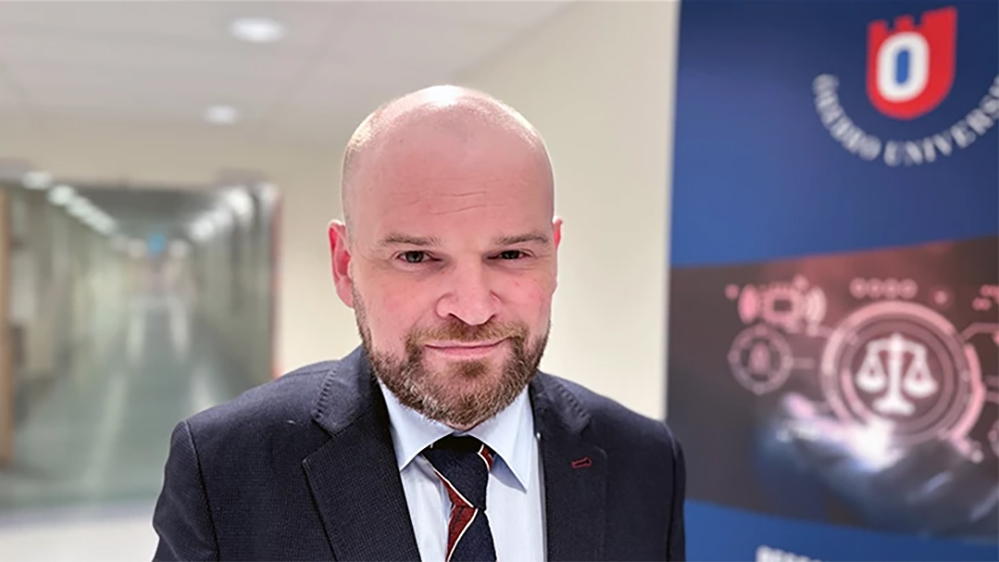
Is it legitimate for private organizations to be tasked with developing the standards on which the EU AI Act is based? This was the focus of the talk by Andrew Leyden, WASP-HS PhD researcher in Legal Science, Örebro University, who was awarded Best Session Talk at this year’s Nordic AI Meet.
The Nordic AI Meet, an event specifically arranged for early career researchers in AI, is hosted by WASP-HS collaborators WASP and NORA among others. This year’s event was particularly focused on social sciences and humanities perspectives on AI.
Andrew Leyden, WASP-HS PhD researcher in Legal Science at Örebro University, was part of the conference program with his talk “Legitimacy in Tension: Who Governs Fundamental Rights under the AI Act?”, for which he was awarded Best Oral Session Talk.
“The award was a pleasant surprise. Nordic AI Meet brought together people from many fields, so I was glad to see that a legal question about who writes the rules for AI resonated beyond law,” says Andrew.
Risks of the EU AI Act
In his talk, Andrew explained that the EU AI Act depends on standards to translate its high‑risk AI requirements into concrete technical rules. These standards are drafted by private organisations, even though they address safeguards intended to protect fundamental rights.
“I ask whether it is legitimate to hand that task to private standardisation, using three lenses: who takes part in writing the standards, how open and accountable the process is, and whether it delivers effective protection,” says Andrew.
Speed and effectiveness often come at the expense of inclusiveness and transparency, and vice versa. The current framework manages this tension but does not resolve it, according to Andrew.
Encouraging Stepping Stone in PhD Journey
“Receiving this award now is encouraging as I head into the next stage of my research journey. The talk I gave is based on the papers in my compilation thesis at Örebro University,” he says.
Already published papers (others are forthcoming):
Leyden, A. (2026). Public Resource Dot EU: Compliance Pathways for the EU Standardisation System After the Malamud Judgment. Laws, 15(3), 45. https://doi.org/10.3390/laws15030045
Leyden, A. (2026). Standards and the EU AI act: legitimacy, state of play, and future challenges. Information & Communications Technology Law, 35(3), 267–297. https://doi.org/10.1080/13600834.2025.2570966