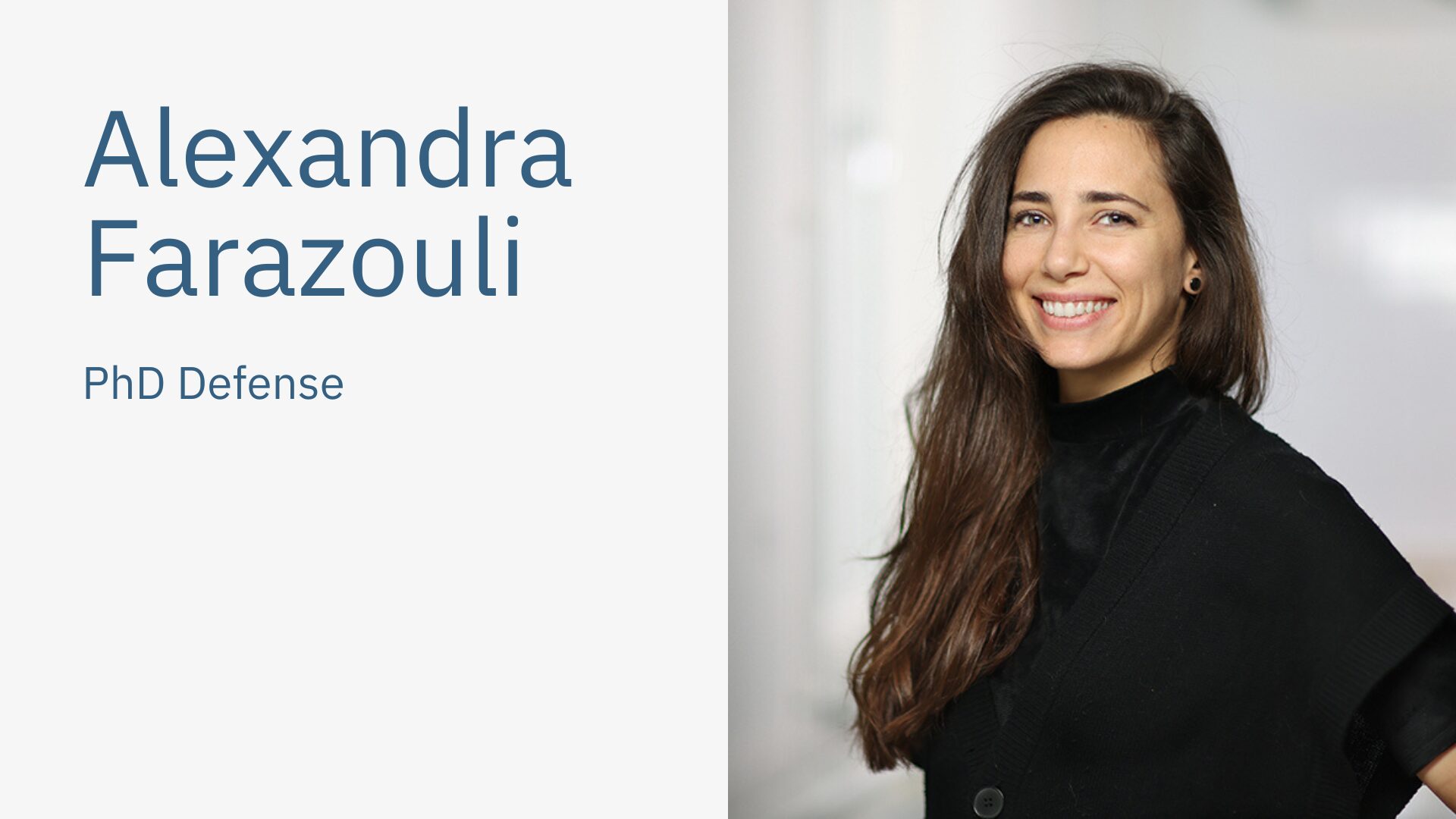
On 8 May 2026, Alexandra Farazouli defends her doctoral thesis, “Emerging AI and Ethics in Higher Education: A Technology Mediation Perspective”, at Stockholm University.
Abstract
The emergence of AI has become a defining issue for higher education worldwide, and Sweden is no exception. At the same time, emerging AI technologies reconfigure priorities and valuations within educational practice by mediating teaching and learning and opening new paths for how teachers and students relate to higher education practices. In this context, AI-mediated practices raise ethical questions that are often presented as unprecedented yet are deeply rooted in longstanding practices in higher education. This thesis undertakes an empirical exploration of AI-mediated practices in higher education, foregrounding teachers’ perspectives and focusing on the ethical issues arising from such mediations. Drawing on postphenomenology and technology mediation theory, the thesis examines how teachers perceive and experience emerging AI artefacts (automated grading systems (AGS) and generative AI (GAI) chatbots) in relation to their practices, and how these artefacts mediate their understandings of what they ought to do and how they ought to act when balancing sometimes competing demands of autonomy and accountability.
The thesis is a compilation of four complementary studies. Study I examines the ethical considerations of AGS, reviewing the literature on AGS and analysing their specificities through a relational ethics approach. This study highlighted that AGS not only introduce technical and procedural considerations but also reconfigure educational practices and relationships in ways that demand ongoing, situated, and relationally attuned ethical reflection. Study II is an interview study with AGS developers who are also university teachers using these systems. It examines their expectations, experiences, and the disruptions that AGS introduce into assessment practices. The findings underscore the ambivalent role of AGS as both promising and disruptive, offering efficiency and consistency, but also introducing ‘new’ frictions and ethical dilemmas. Study III is a study inspired by the Turing test, followed by focus group interviews with university teachers. It explores how GAI chatbots mediate teachers’ perceptions of their assessment practices. The findings indicate that the presence of GAI chatbots, allowing the possibility of AI-generated writing, shapes evaluation practices, prompting teachers to question authorship and, in some cases, reinforcing mistrust within the student–teacher relationship. Study IV is a focus group interview study examining how teachers experience and interpret the emergence of GAI and how it mediates their perceptions of their professional roles. Participants described GAI as both disruptive and potentially transformative. They were compelled to reconsider assessment formats, teaching priorities, and their responsibility to foster critical and ethical engagement with technology.
The combined findings of the four studies show that the emergence of AI unsettles established practices and intensifies the uncertainties that characterise educational situations, placing greater demands on teachers’ professional judgment. The thesis also argues that the emergence of AI exposes and amplifies longstanding ethical issues, such as fairness, academic integrity, and equity, reshaping how these issues are understood and enacted as the technologies become embedded in higher education practices.
Supervisor
Cormac McGrath, Associate Professor, Department of Education, Stockholm University.
Teresa Cerratto Pargman, Professor, Department of Computer and Systems Sciences, Stockholm University.
Klara Bolander Laksov, Professor, Department of Education, Stockholm University.
Opponent
Wayne Holmes, Professor, Institute of Education, University College London (UCL).