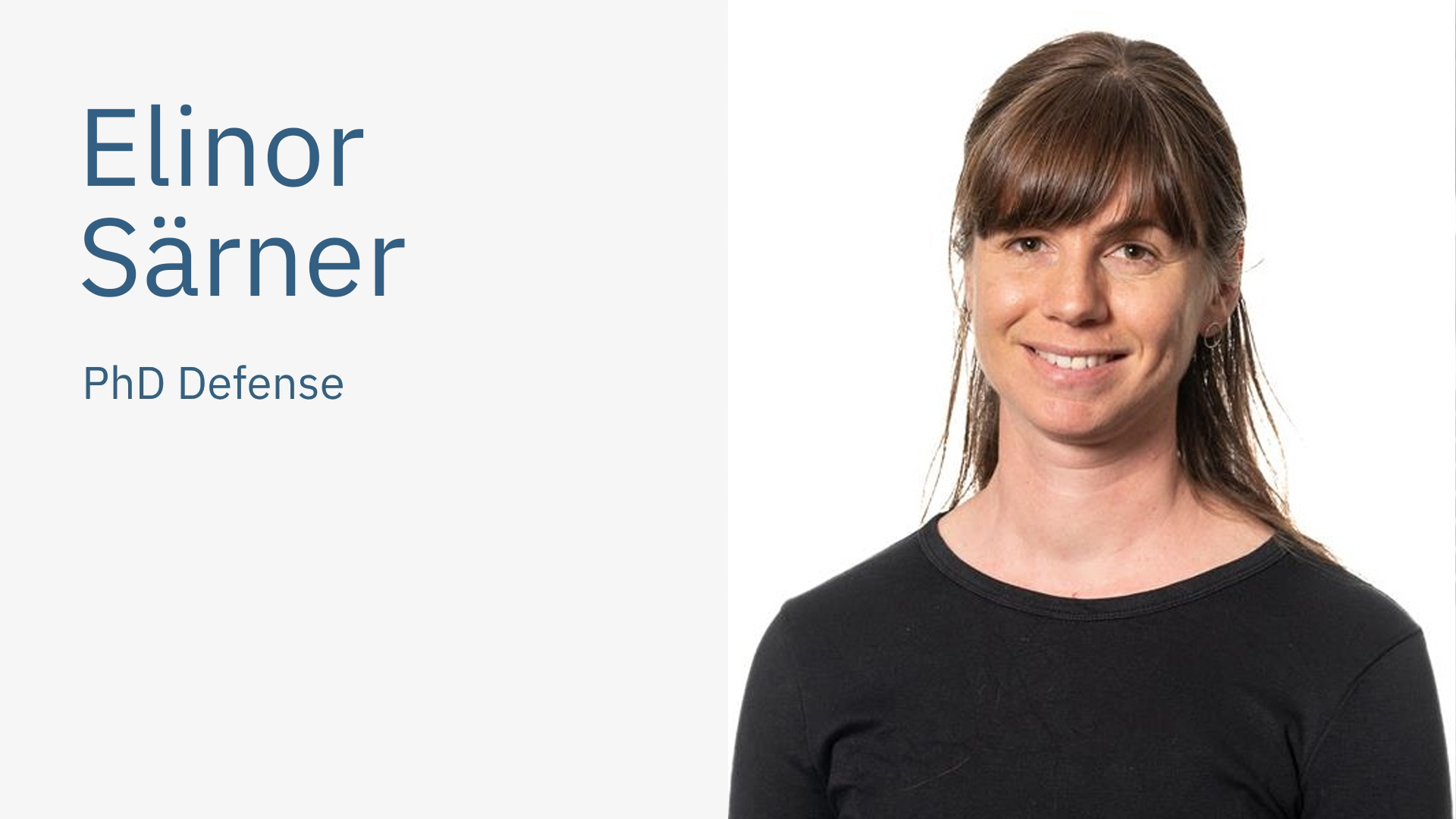
Elinor Särner defends her doctoral thesis, “Repairing Creative AI: Critical explorations of frictions, reconfigurations, and reflexivity“, on June 5, 2026, at Linköping University.
Abstract
Technological development is an integral part of human life that both shape and is shaped by society. In today’s volatile society, anticipating and interpreting emerging changes is crucial to face future challenges. The predictive abilities of Artificial Intelligence (AI) can support planning in such conditions. Yet AI adoption remains slow in sectors such as energy systems, and urban development, which are characterized by entangled dependencies, critical social services, and multiple involved actors and stakeholders, making planning and management challenging. This thesis addresses key questions about how AI, which relies on historical data, can support future-oriented planning processes in such complex systems. From an innovation management point of view, AI integration is organizationally challenging, shaped by interacting internal and external dynamics – such as tasks, workflows, technical prerequisites, and societal trends – calling for a holistic socio-technical perspective to ensure feasibility and desirability.
This thesis promotes “cooperative intelligence” emphasizing humans’ and AI’s reciprocal dependencies. AI-integration in complex system planning relies on collective sensemaking, especially in the process of constructing meaning of potential futures and identifying possible actions to shape those futures. AI’s predictive ability can guide the navigation of uncertainty and ambiguity in this process and contribute as boundary objects in mediating meaning across domain and organizational boundaries. However, it can also embed historic conditions and introduce new uncertainties. This duality calls for conscious involvement and negotiation among diverse actors.
This thesis sets out to explore how humans together with AI make sense of potential futures in complex system planning building on two empirical studies in the Swedish energy sector. The first study follows the development of an AI-prototype to assist planning of energy systems in new city districts. The second study investigates the implementation of an AI-tool to assess impacts of societal trends on the future energy system.
The thesis contributes to existing literature by informing how AI connects temporal dynamics of imagination and action in human-AI cooperation, how it reconfigures cross-boundary collaboration, develops the notion of intelligent boundary objects, and how organizational structures need to evolve. It contributes to innovation management research, detailing how AI-integration shapes prospective sensemaking and strengthens organizational planning capabilities.
Supervisors
Anna Yström, Professor at the Department of Management and Engineering, Linköping University
Susanne Ollila, Professor, Entrepreneurship and Strategy, Technology Management and Economics
Opponent
Kirsimarja Blomqvist, Professor of Knowledge Management, LUT University Business School