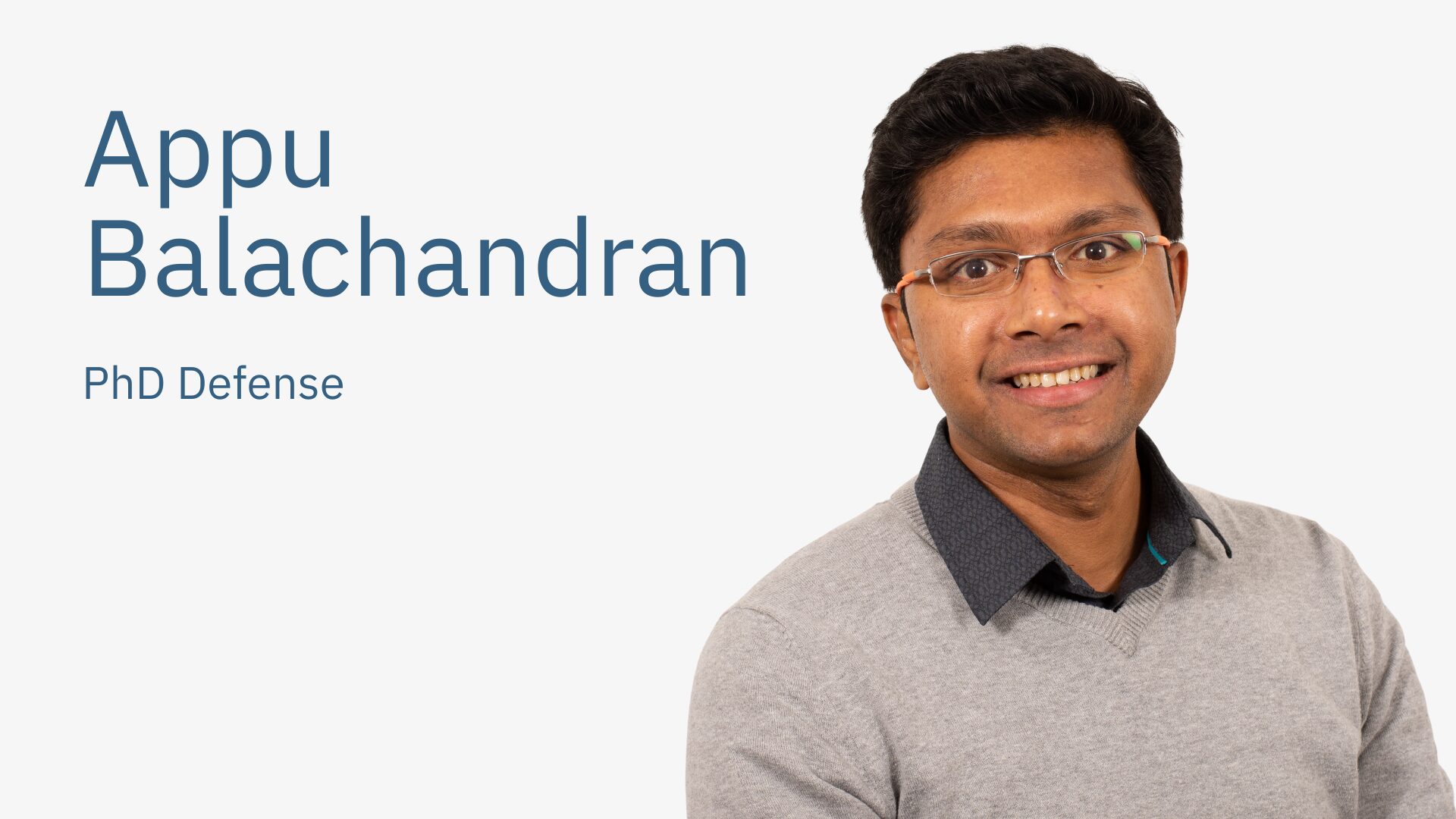
On 29 May 2026, Appu Balachandran defends his doctoral thesis, “The Development of Complex Intelligent Systems: A Study of Engineering and Project Management Approaches“, at Linköping University.
Abstract
Advances in software and artificial intelligence (AI) are rapidly transforming society. Many of the systems that underpin everyday life, such as aircraft, vehicles, energy systems, and transportation infrastructure, are complex technical systems that are becoming increasingly software-intensive. As these systems gain the ability to make decisions, learn from data, and adapt to their environment, they evolve into what this thesis refers to as Complex Intelligent Systems (CoIS).
This thesis examines how the development of such systems is changing as software and AI grow in importance, with a particular focus on engineering and project management approaches. Traditionally, complex systems have been developed using systems engineering, often supported by model-based approaches to ensure structured, traceable, and predictable development. At the same time, development projects have typically been organized through phase-based Stage-Gate processes.
However, the growing integration of software and AI has led to the emergence of data-driven engineering approaches and more iterative and flexible agile practices. This thesis investigates how these different approaches interact in the development of CoIS.
The study is based on interviews with experts from the aviation, automotive, and naval industries, complemented by an in-depth case study in the automotive domain. The findings show that the development of CoIS rarely involves replacing established approaches with new ones. Instead, organizations need to combine multiple approaches simultaneously. Model-based approaches remain essential for safety-critical systems, while data-driven and agile approaches are required to support learning and adaptability. This creates fundamental tensions between predictability and control on the one hand, and learning and flexibility on the other. The thesis contributes to understanding these tensions by showing that it is not only merely a practical or methodological challenge, but rooted in fundamentally different underlying logics of development embedded in the approaches used.
The results also highlight the role of system architecture as a key mechanism for managing this complexity. By structuring systems appropriately, organizations can combine different development approaches without compromising safety or functionality. Overall, the main challenge is not choosing a single approach, but managing the interplay between multiple approaches across both the system and the organization.
This thesis contributes by providing an integrated perspective on the development of CoIS and by identifying the organizational and managerial challenges that arise when different development logics intersect. As CoIS development is still evolving, further research is needed to understand how organizations can develop the capabilities required to manage these dynamics over time and across industries.
Supervisor
Gunnar Holmberg, Adj. Professor, Linköping University (Main supervisor)
Nicolette Lakemond, Professor, Linköping University (Co-supervisor)
Gouthanan Pushpananthan, Assistant Professor, Linköping University (Co-supervisor)
Opponent
Tobias Larsson, Professor, Blekinge Institute of Technology.