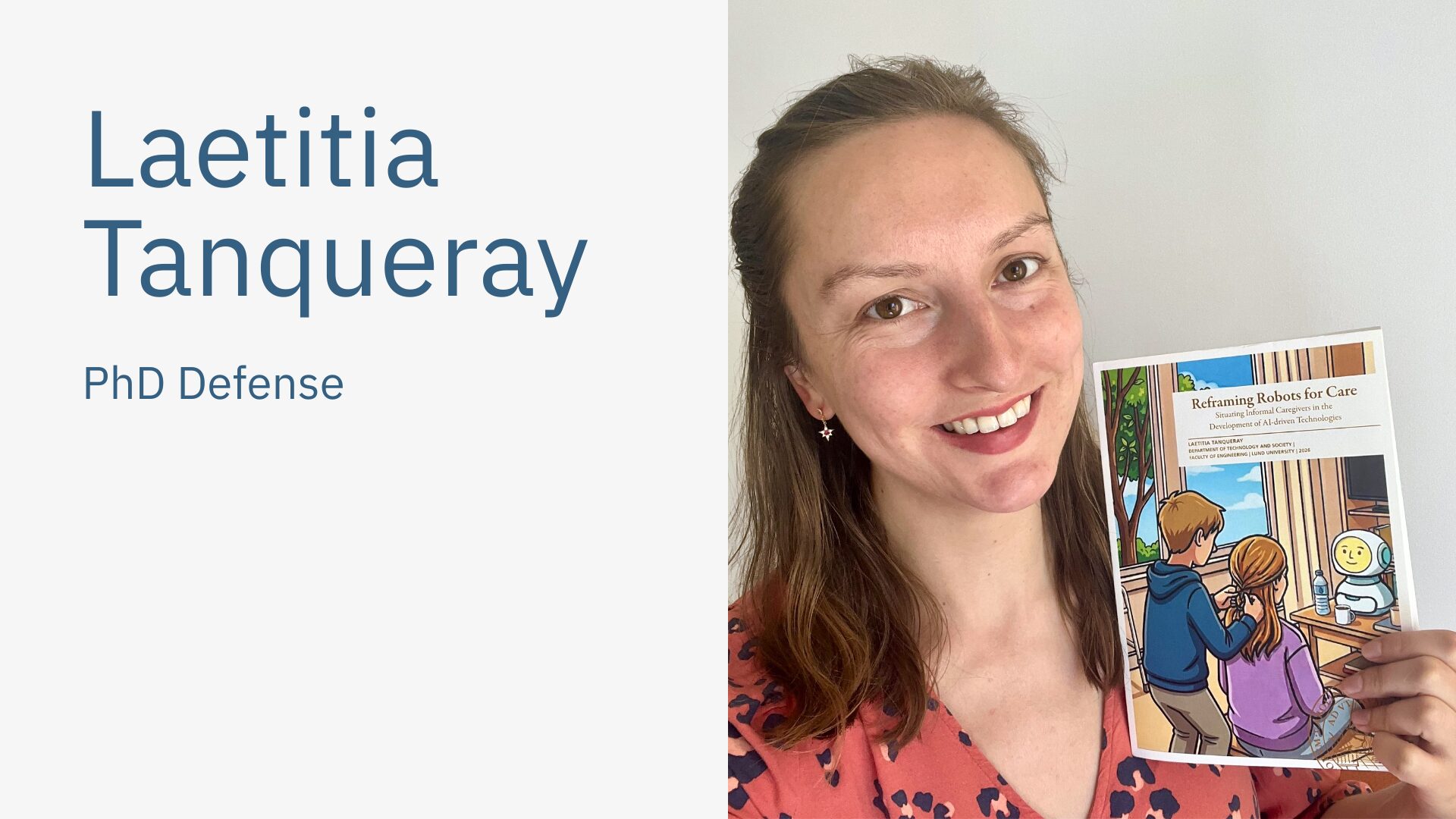
On 22 May 2026, Laetitia Tanqueray defends her doctoral thesis, “Reframing Robots for Care: Situating Informal Caregivers in the Development of AI-driven Technologies”, at Lund University.
Abstract
The current framing of AI-driven technologies situates them as solutions to a looming care crisis. However, this overlooks informal caregivers’ key role to current State budgetary deficits impacting healthcare services happening in Europe. As States increasingly rely on informal caregivers to provide care before the necessary involvement of healthcare services, there is already well-established research on the growing care demands on informal caregivers. Yet, in the development of AI-driven technologies, little attention has been given to this group. To attend to this gap, this thesis situates informal caregivers in order to reframe current developments of AI-driven technologies for care.
The aims of this thesis are therefore grounded in visibilising and situating informal caregivers within the development of AI-driven technologies. This is achieved in two ways: (1) by conducting interdisciplinary research on informal caregivers to bring forth the significance of critical social sciences in Human-Robot Interaction on health care as well at times Human-Computer Interaction; and, (2) shedding light on current societal challenges on care regarding informal caregivers, especially informal caregivers under the age of 18 (referred to as young carers), to the development of AI-driven technologies. The first aim is directed at the academic community, whilst the second aim is directed towards society by empowering specific stakeholders in envisioned AI-driven technologies as artefacts. To answer to those aims, a socio-legal STS theoretical lens is established, to bring forth the power of law, social norms, plans and situated knowledge and care.
The findings are based on four scientific papers, which report on HRI research practices on health care (Paper I), a theoretical framework to account for norms within adaptive technologies (Paper II), positioning young carers into AI-driven technologies (Paper III), and finally, an empirical study on young carers’ perspectives of robots for care (Paper IV). These ultimately showcase that the development stage of this technology provides a pivotal opening to include informal caregivers, ahead of deployment. This thesis offers hope on how to attend to an overlooked stakeholder, namely informal caregivers. This includes reflections on including a group that has previously been neglected from AI research, namely young carers, and how to do so ethically.
Supervisor
Stefan Larsson, Supervisor, Lund University
Katie Winkle, Assistens supervisor, Uppsala University
Opponent
Sara Ljungblad, Chalmers University of Technology